
Logo CIMPA

2027

Learning over Structured High-Dimensional Objects: Theory and Complexity

Many modern, large-scale datasets are structured as graphs, matrices, tensors, and other combinatorial objects. A central challenge across mathematics, statistics, and theoretical computer science is to understand the limits of inference, when these limits can be achieved computationally, and where fundamental barriers arise.
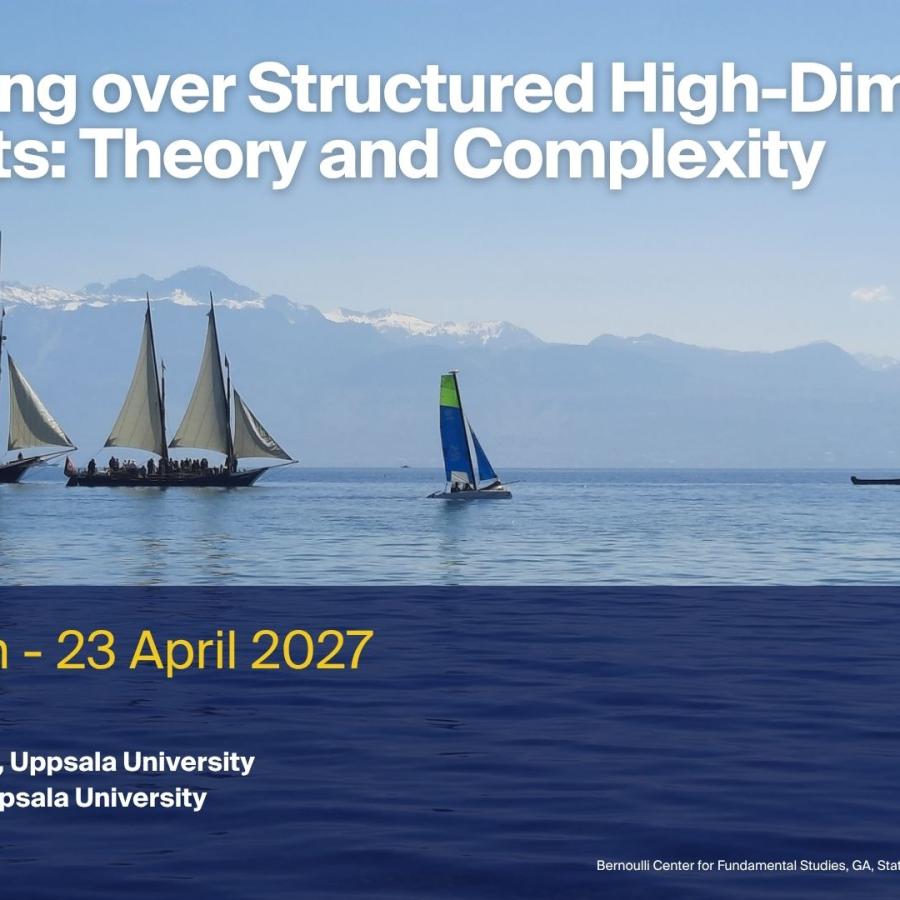

Mon. 15 Mar, 2027 → Fri. 23 Apr, 2027

Geometric topology and its friends

While landmark achievements by Perelman, Agol, and others have recently resolved major questions in dimension 3, the field of low-dimensional topology remains vibrant. Significant challenges persist—such as the L-space conjectureand the smooth Poincaré conjecture in dimension 4—alongside emerging questions at the intersection of various mathematical disciplines.


Mon. 25 Jan, 2027 → Fri. 26 Feb, 2027

This is a special track collaborative workshop taking place in Switzerland. 

IMPORTANT: This event is primarily for participants based in a developing country following IMU-CDC classification. However, as this event happens in Europe, we exceptionally accept applications from students based in Europe under the condition that they have done their studies till the end of undergraduate level in a developing country.

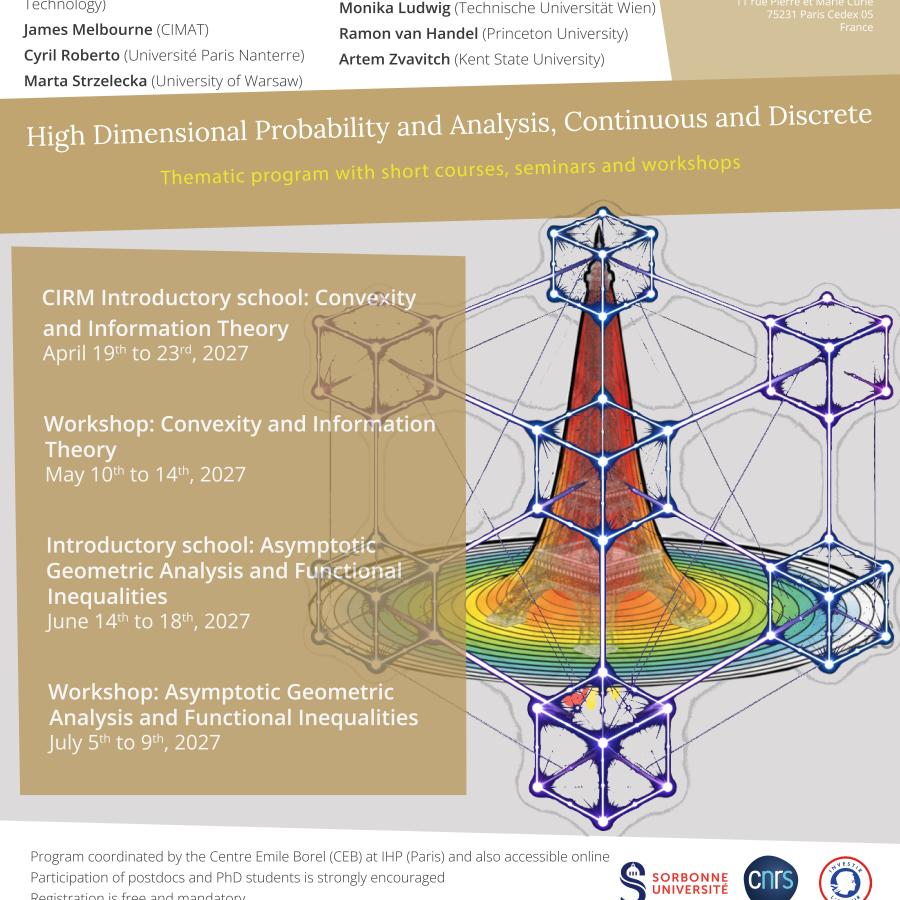
High Dimensional Probability and Analysis, Continuous and Discrete

Recent trends at the interface between information theory, probability, statistics and high-dimensional geometry raise new questions on the role and importance of entropy in the understanding of both asymptotic and finite range phenomena, in particular towards discrete structures and applications to areas such as quantum information, percolation and random matrices. Recent fruitful developments warrant imminent blossom of new ideas and results in this area in the near future.

Mon. 19 Apr, 2027 → Fri. 09 Jul, 2027

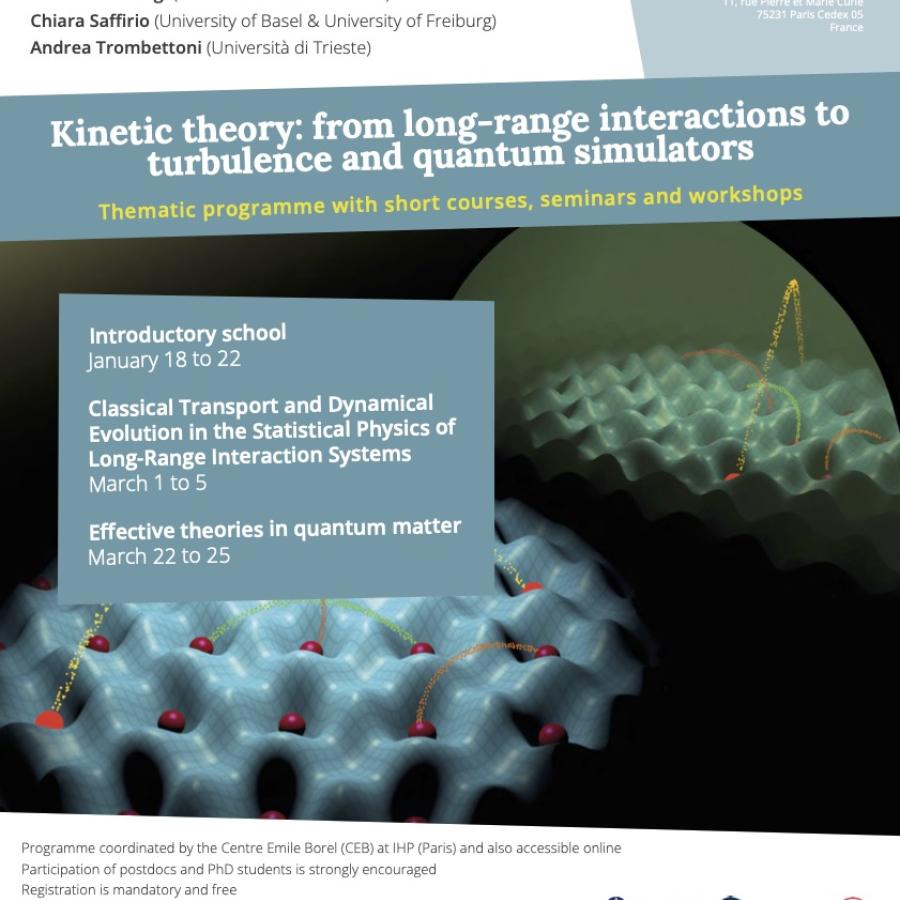
Kinetic theory

The program centers on the development of a unified understanding of kinetic theory in systems with long‑range interactions, with a particular emphasis on the quantum regime. Long‑range interacting quantum systems—realized experimentally in cold atoms, trapped ions, and polar molecules—exhibit rich dynamical behavior such as metastability, collisionless dynamics, anomalous transport, critical scaling, and turbulence‑like phenomena.

Mon. 18 Jan, 2027 → Fri. 09 Apr, 2027

Density Functional Theory (DFT) is a widely used computational method for addressing the quantum-mechanical many-body problem, with applications across fields such as quantum chemistry, materials science, geology, astrophysics, and biophysics. DFT-based simulations are used to study materials important for key technological and societal applications, with particular relevance to major challenges in Africa. Because of its broad relevance, DFT is an essential part of the training of master’s and PhD students. The widespread use of DFT is partly due to freely available computational codes.

The CIMPA School on Algebraic and Enumerative Combinatorics will take place from July 19–30, 2027 at Makerere University in Kampala, Uganda. The school aims to introduce graduate students and early-career researchers to modern developments in enumerative and algebraic combinatorics and their connections to other areas of mathematics and computer science. Although combinatorics research is still developing in Uganda and parts of Africa, there is a growing community of researchers and students interested in the subject.

Partial Differential Equations (PDEs) are fundamental tools for modeling natural phenomena across the physical, biological, and social sciences, describing systems that evolve in space and time. This summer school, "Modern Perspectives on PDEs: Theory and Applications," explores classical foundations alongside the expanding frontier where PDEs intersect with data science and machine learning. The program offers a unique blend of theory and practice.

The school aims to introduce students and young researchers to several important research directions in mathematical biology, with a focus on deterministic mathematical models used to describe complex biological processes. These models play a central role in understanding phenomena such as population dynamics, epidemiology, tumor growth, and respiratory system functioning. Part of the program will focus on the mathematical modeling of biological populations using structured population dynamics and transport equations.