
Logo CIMPA

France

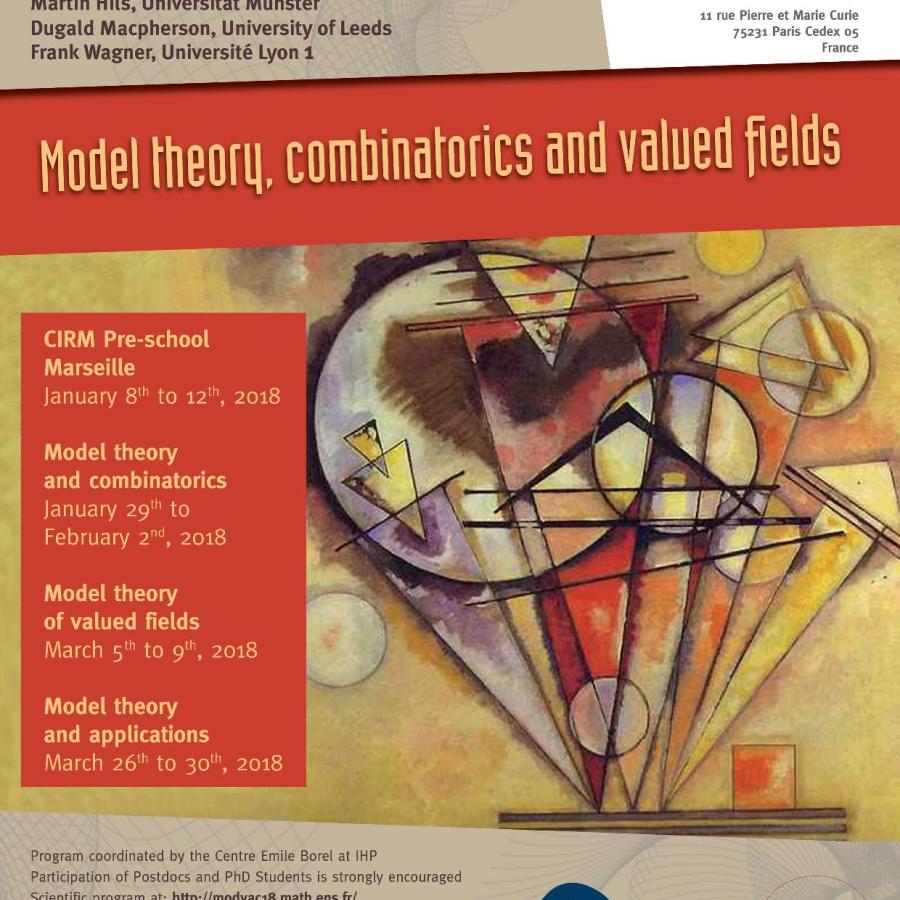
Model theory, combinatorics and valued fields

Model theory is a branch of mathematical logic which deals with the relationship between formal logical languages (e.g. first order logic, or variants such as continuous logic) and mathematical objects (e.g. groups, or Banach spaces). It analyses mathematical structures through the properties of the category of its definable sets.

Mon. 08 Jan, 2018 → Fri. 06 Apr, 2018

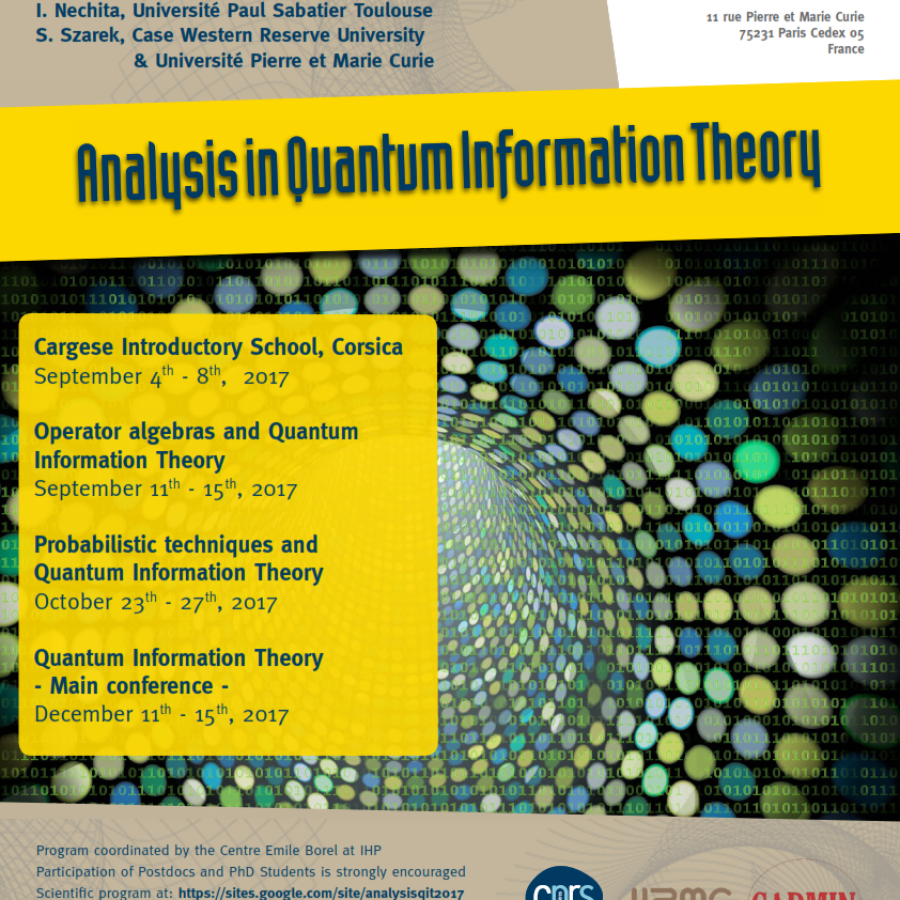
Analysis in Quantum Information Theory

Quantum Information Theory (QIT) is a rapidly developing field whose significance ranges from fundamental issues in the foundations of quantum theory to new state-of-the-art methods for secure transmission of information.

Mon. 04 Sep, 2017 → Fri. 15 Dec, 2017

Combinatorics and interactions

The main goal of this trimester is to give to researchers in combinatorics the opportunity to meet and work together. More precisely, we aim at gathering people from the three following wide themes:

Mon. 09 Jan, 2017 → Fri. 31 Mar, 2017

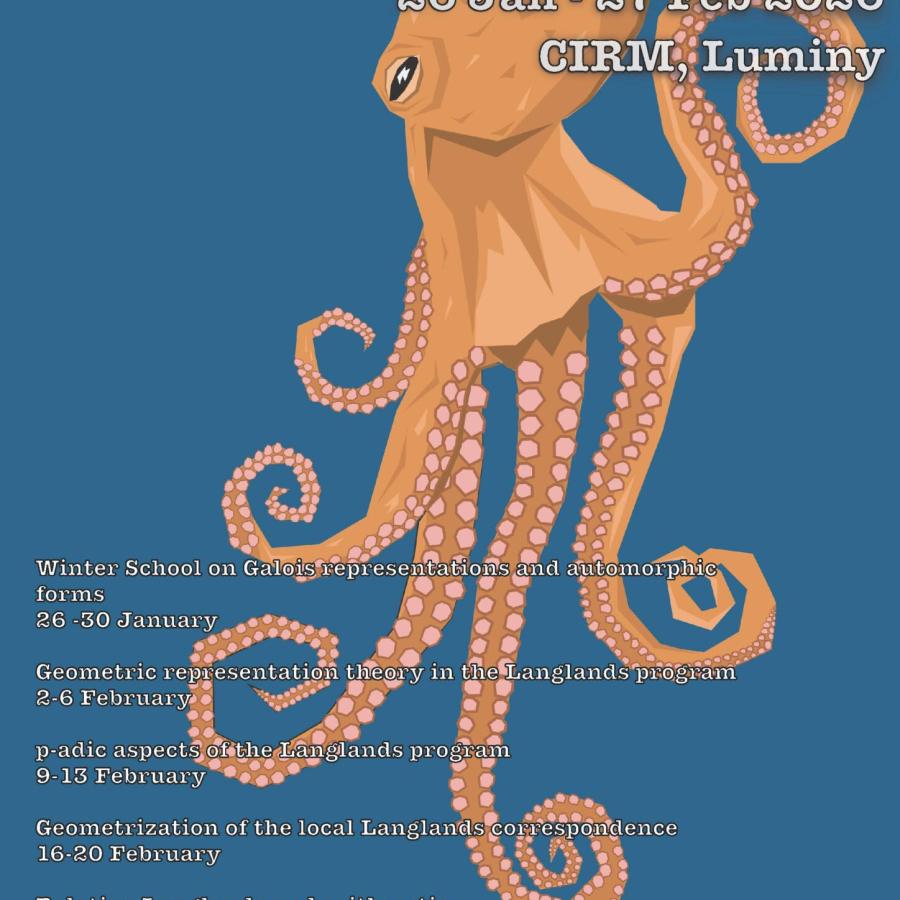
Around the Langlands program

Born in a letter of Robert Langlands to André Weil in 1967, the Langlands program seeks to establish a far-reaching web of conjectures relating seemingly distant areas of mathematics, primarily number theory, representation theory, and algebraic geometry

This thematic month will focus on some of the most important current directions of this program: the geometric Langlands program, the p-adic Langlands program, the geometrization of the Langlands program, and relative Langlands duality.

Mon. 26 Jan, 2026 → Fri. 27 Feb, 2026

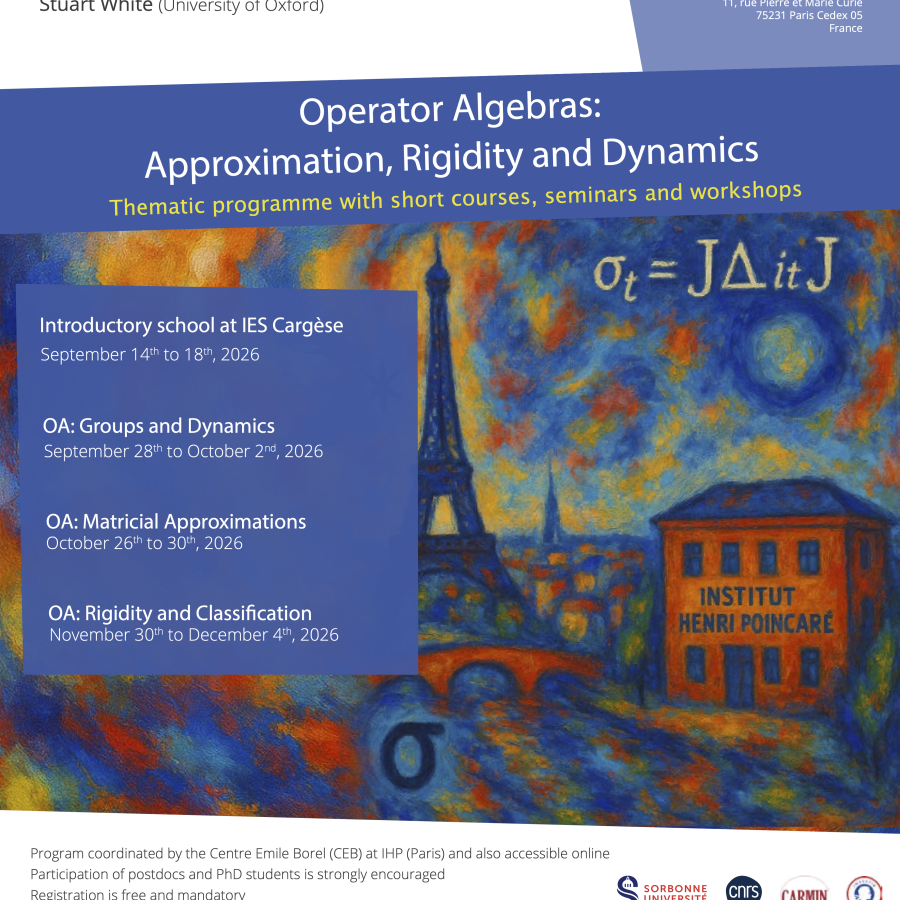
Operator Algebras: Approximation, Rigidity and Dynamics

Operator algebras are self-adjoint subalgebras of the bounded operators on a Hilbert space and divide into two main classes: C∗-algebras and von Neumann algebras, according to whether one demands that they are closed in the norm topology or the weak operator topology.

Mon. 14 Sep, 2026 → Fri. 04 Dec, 2026

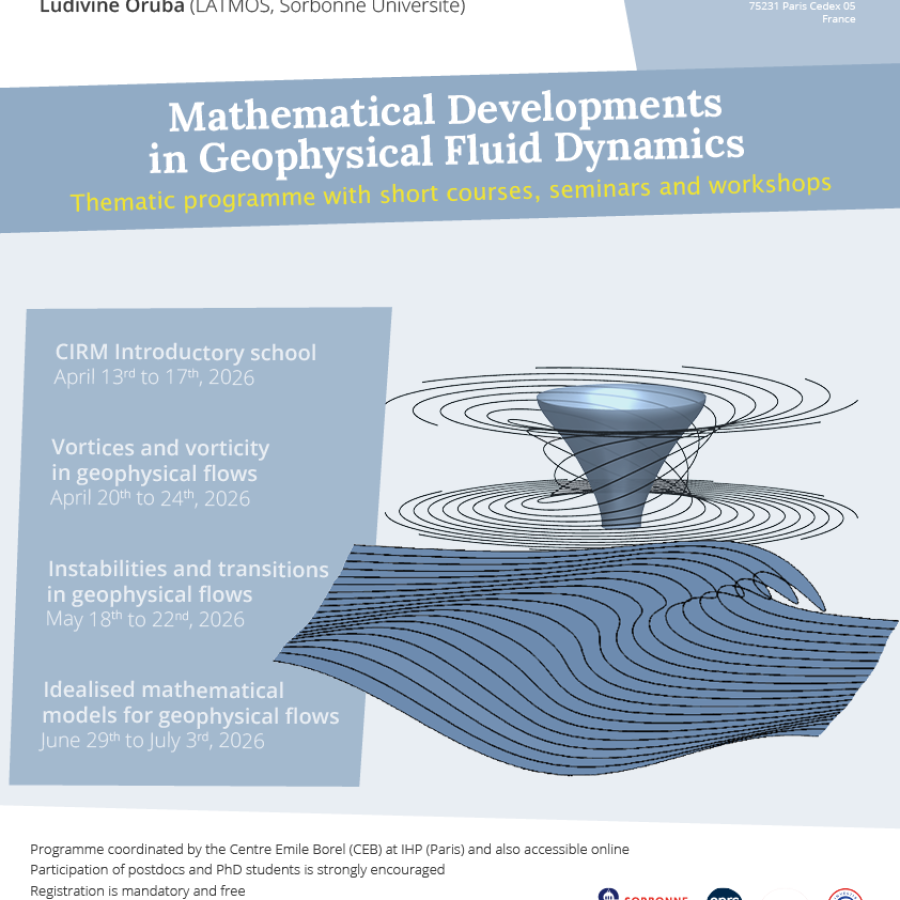
Mathematical Developments in Geophysical Fluid Dynamics

Geophysical Fluid Dynamics covers a wide range of applications in atmospheric and oceanic sciences with direct connections to the challenges of climate change. Historically studied by physicists and applied mathematicians, rotating fluids have been the subject of many recent results involving the analysis of PDEs. However, exchanges between these communities remain relatively rare and isolated.

Mon. 13 Apr, 2026 → Fri. 10 Jul, 2026

Quantum Computing

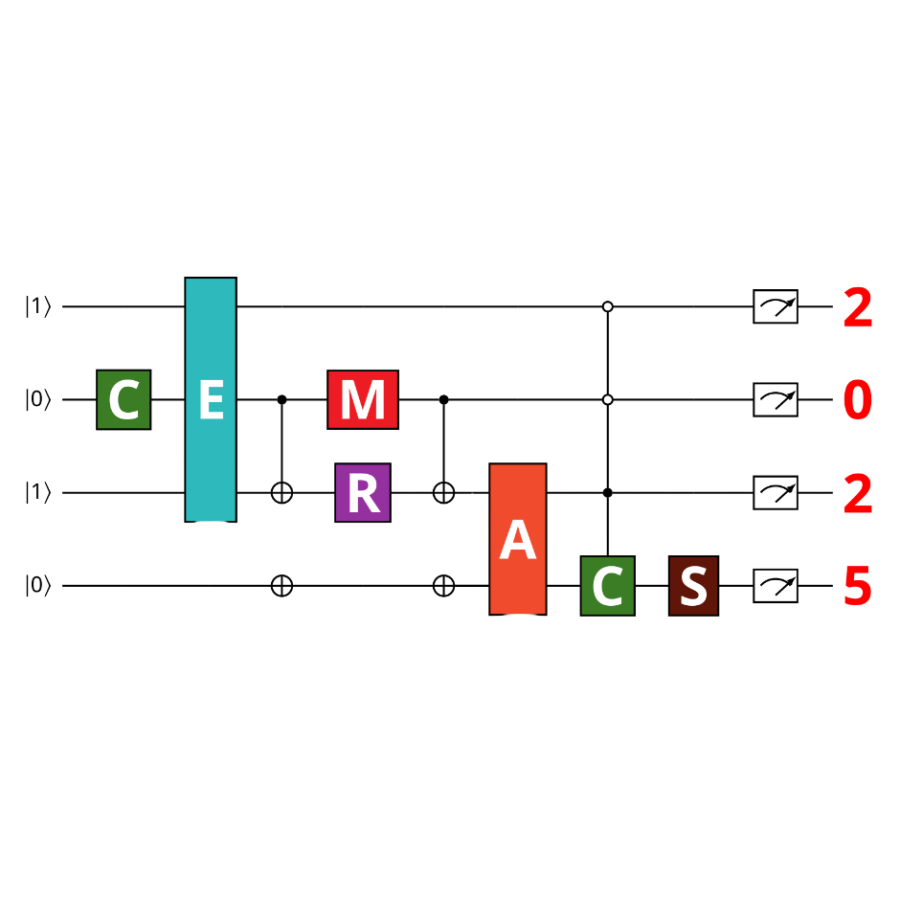
CEMRACS is a 6-week international summer school organized almost every summer since 1996 at CIRM (Centre International de Rencontres Mathématiques) on the Luminy campus near Marseille famous calanques. In 2025, the event will be dedicated to Quantum Computing with a special emphasis on two scientific domains deeply impacted by quantum computers with important social repercussions : scientific computing and cryptography.

Tue. 15 Jul, 2025 → Fri. 22 Aug, 2025

Illustration as a Mathematical Research Technique

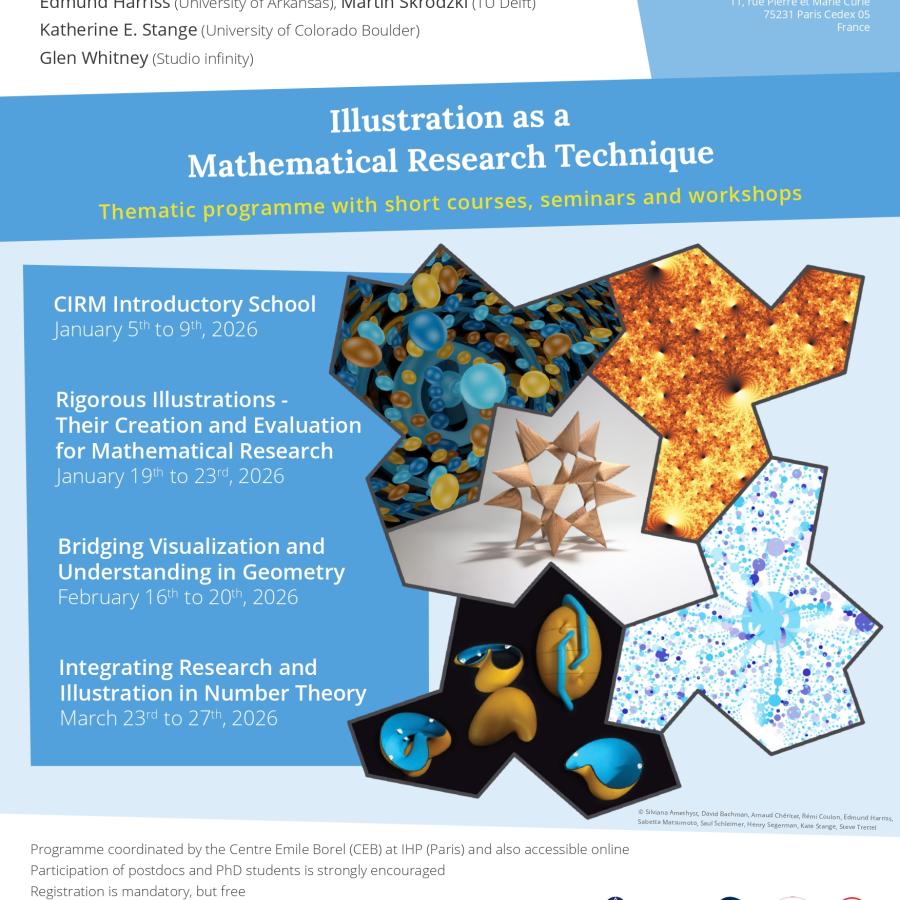
Mathematical understanding is built in many ways. Among these, illustration has been a companion and tool to research for as long as research has taken place. We use the term illustration to encompass any of the many ways one might bring a mathematical idea into physical form or experience, including computer visualization, 3D printing, and virtual reality, among others. With modern tools, illustration can even make mathematics an experimental science, so that computational results can drive the cycle of problem, conjecture, and proof.

Mon. 05 Jan, 2026 → Fri. 03 Apr, 2026

Higher Rank Geometric Structures

The study of discrete subgroups of semisimple Lie groups is a field with a long history and, at same time, a very active topic of research. It is at the core of several fields, ranging from differential geometry to number theory and since Margulis's breakthrough in the 70's, it is intimately related with dynamical systems.

While the subsequent developments account for rigidity phenomena, our program will be focused on geometric aspects of flexible discrete groups.

Sun. 13 Apr, 2025 → Fri. 11 Jul, 2025

Group Actions and Rigidity: Around the Zimmer Program

This term focuses on rigidity of group actions with some focus on issues that arise out of Zimmer's groundbreaking work in the 1980's. Areas of interest range from local and global rigidity of group actions to special rigidity phenomena in small dimensions to symmetry groups of geometric structures to measure rigidity results for quite general group actions with hyperbolicity. This broad area has seen a very large number of dramatic breakthroughs in recent years.

Sun. 14 Apr, 2024 → Fri. 05 Jul, 2024