Fabio Gironella


Xavier Massaneda
Claudia Schoemann

Computers are transforming modern mathematics. From testing conjectures to verifying deep theorems, computer-assisted reasoning is becoming an essential tool across pure and applied mathematics. This course offers a hands-on introduction to one of the most exciting developments in contemporary mathematics: formal proof verification.
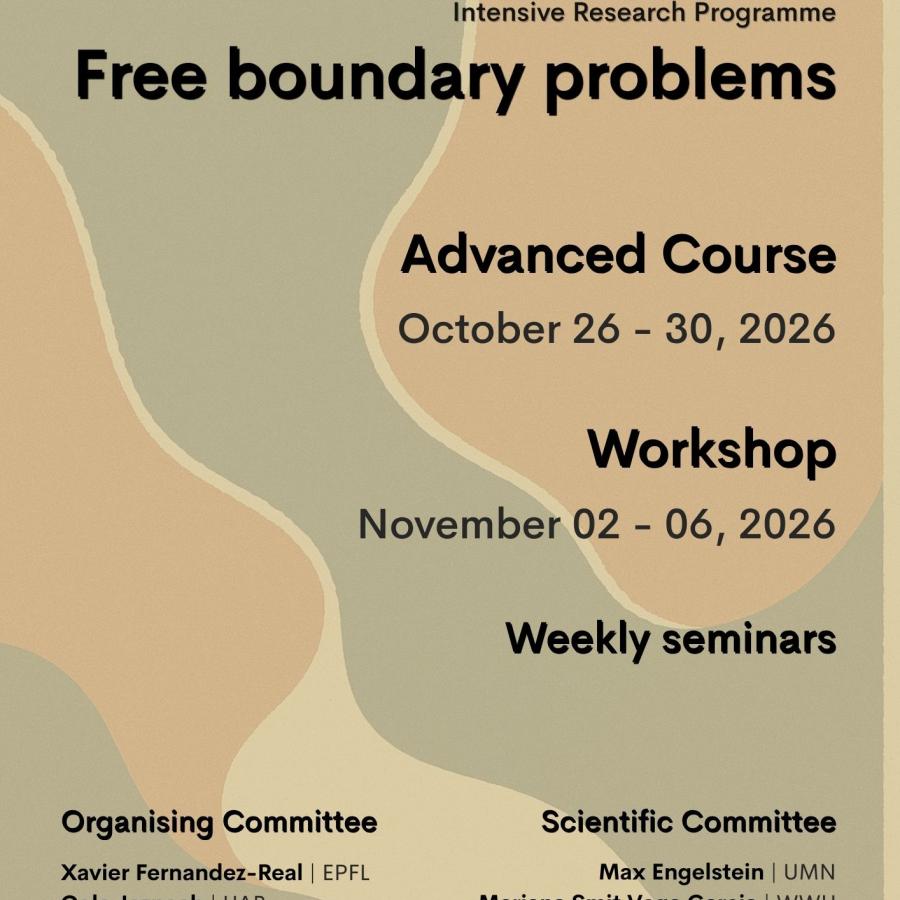
The CRM opens an annual call for CRM Intensive Research Programmes (IRP) approximately two years in advance. The CRM started organising IRPs in 2003 and has held two to three per year since then. Each programme consists of a number of resident researchers, from junior to senior, and at least two scientific events (workshops, advanced courses, and conferences).
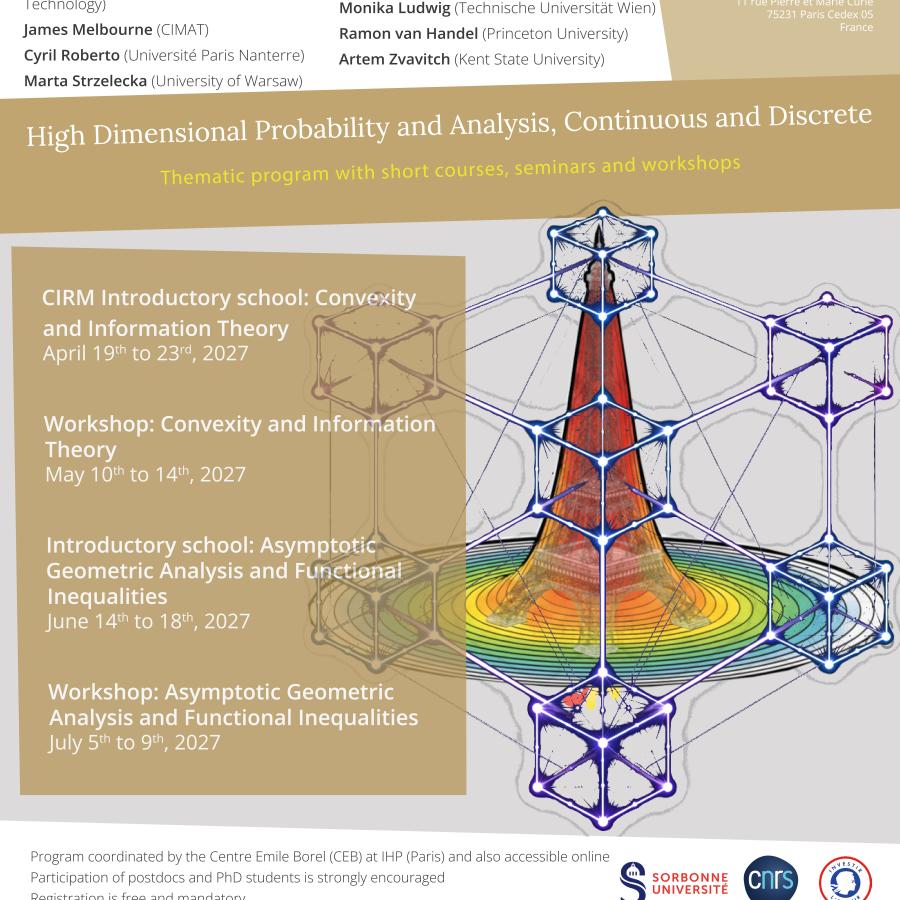
Recent trends at the interface between information theory, probability, statistics and high-dimensional geometry raise new questions on the role and importance of entropy in the understanding of both asymptotic and finite range phenomena, in particular towards discrete structures and applications to areas such as quantum information, percolation and random matrices. Recent fruitful developments warrant imminent blossom of new ideas and results in this area in the near future.
Coordinators: Meltem Unel (unel@lipn.univ-paris13.fr), Ilayda Baris (ilaydabaris@nesinkoyleri.org)
Coordinators: Abdeljalil Nachaoui (Abdeljalil.Nachaoui@univ-nantes.fr), Fatima M. Aboud (Fatima.Aboud@sciences.uodiyala.edu.iq)
Coordinators: Lê Minh Hà (leminhha@viasm.edu.vn)
Joaquim M. C. Correia (jmcorreia@uevora.pt)
Timothy G. Myers (tmyers@crm.cat)
Hoang Van Ha (hvha@hcmus.edu.vn)
Coordinator: Dr. Made Tantrawan (Universitas Gadjah Mada, Indonesia) made.tantrawan@ugm.ac.id